Friction wins the challenge track at the 2026 EduX Oceania Hackathon
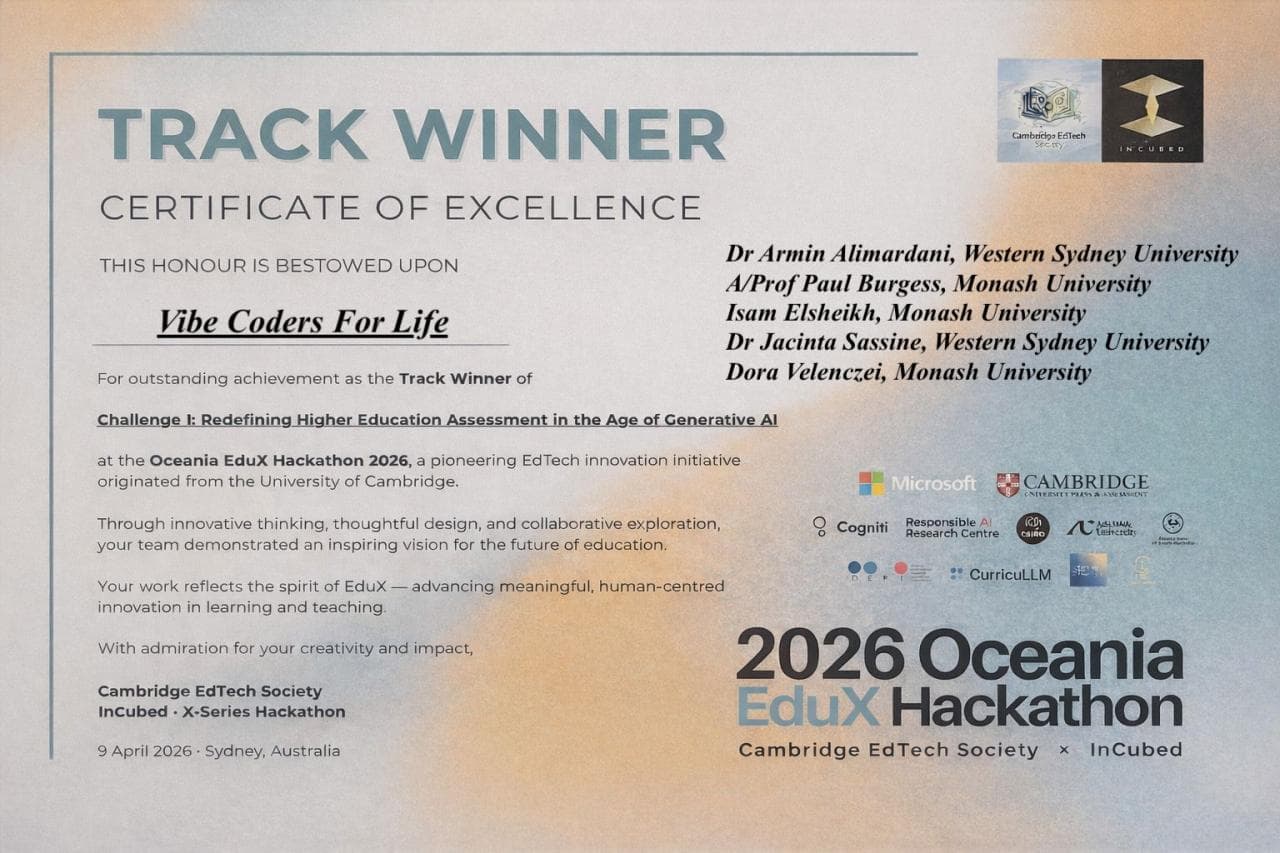
Track Winner, Challenge I: Redefining Higher Education Assessment in the Age of Generative AI. 2026 Oceania EduX Hackathon, Sydney.
On 21 April 2026, a team drawn from the Technology and AI in Legal Education Research Lab (TAILER Lab) at Monash, with collaborators from Western Sydney University, entered the 2026 EduX Oceania Hackathon. The event was hosted in Sydney by the Cambridge EdTech Society and ran four challenge streams over four days, with eight teams of up to five participants in each stream. The team selected Challenge I: Redefining Higher Education Assessment in the Age of Generative AI.
The framing
The team settled on its framing during the first brainstorming meeting. The problem is not that students use generative AI; the problem is the cognitive shortcuts that follow once AI-assisted work becomes routine. Verification, questioning, and critical engagement with sources are skipped, which undermines the educational purpose of the assessment. A useful tool, in this framing, is one that permits AI use and introduces friction at the moments where engagement begins to fall away. The product name followed from the framing.
The architecture
The design has three layers. Layer 1 is a familiar AI chat interface embedded in an assessment workspace, with prompts, responses, paste events, and timing captured as part of the assessment record. Layer 2 is the Companion Peer, an observer that watches the interaction between the student and the AI rather than the student, and that intervenes when patterns suggest disengagement. The intervention is framed as coaching rather than supervision. Layer 3 runs at submission. It reads the final work alongside the interaction record and produces a process report for the educator, including how the student engaged with prompts and whether their approach changed across the task.
The build and the pitch
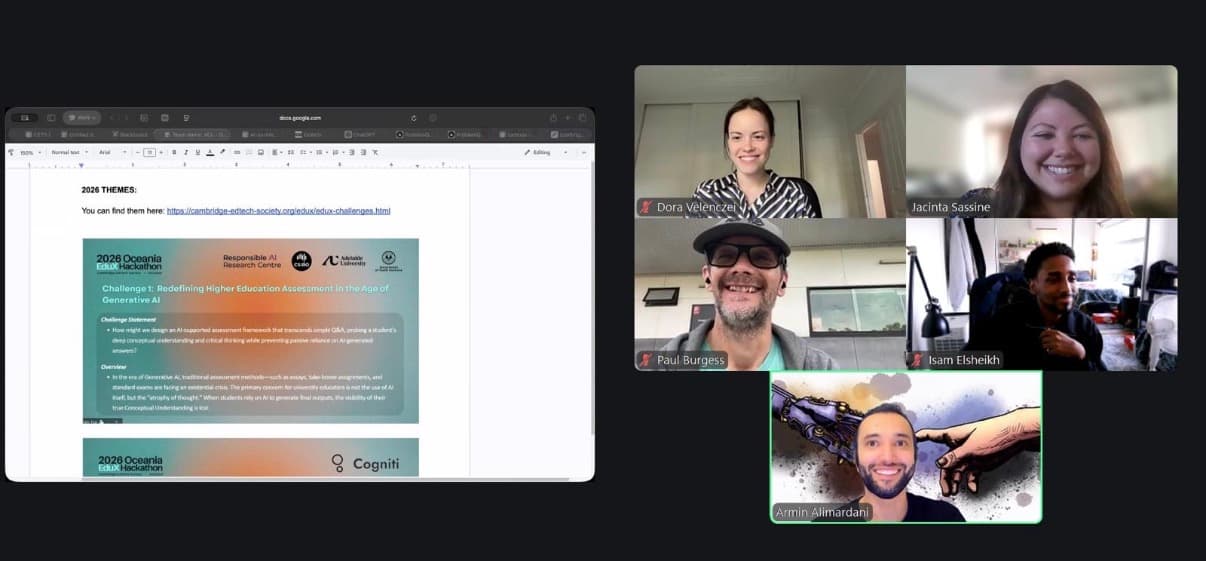
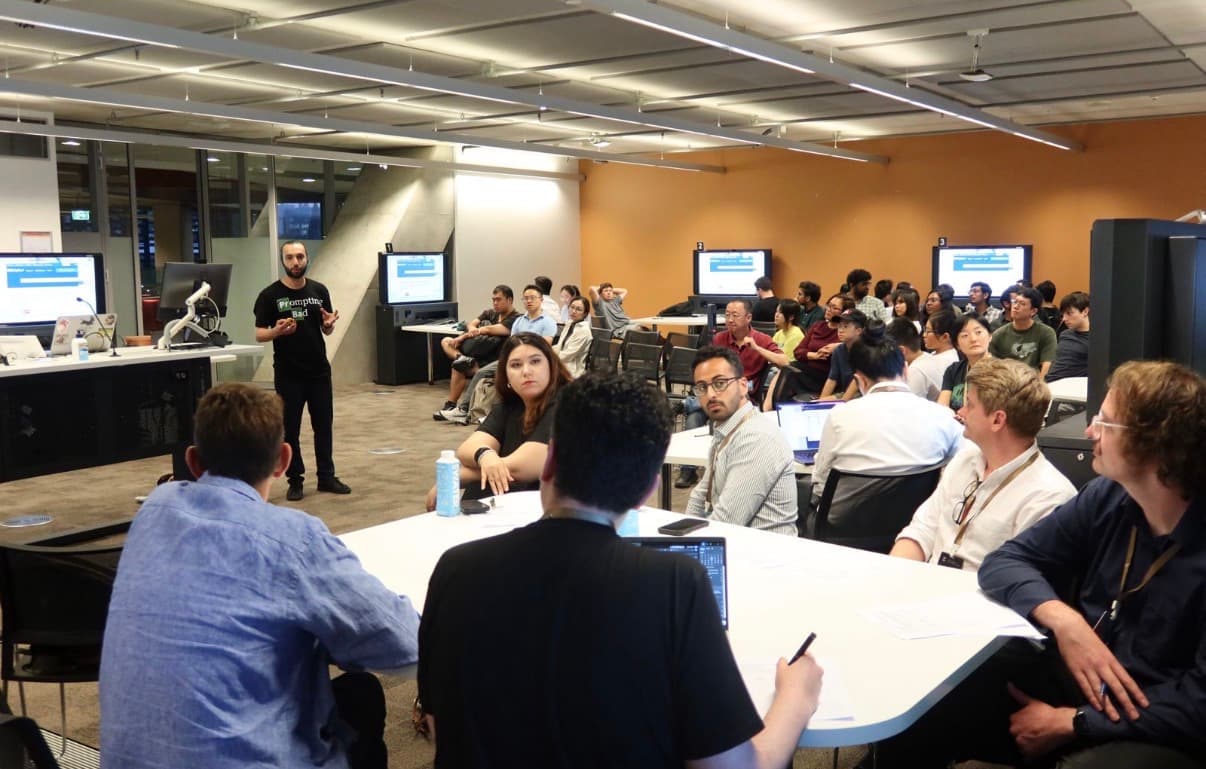
Most of the team worked remotely. The build began on Good Friday and reached a functional state by the end of that day. The remaining time was spent on refinement, prompt engineering, and preparation for the final pitch. Armin Alimardani presented in person on behalf of the team in Sydney and did an excellent job. Judging combined a formal pitch with a conversational round in which judges spoke with each team in turn.
The result
The team, entered as Vibe Coders For Life, was announced as the winner of Challenge I. The challenge-track winners progressed to a grand final round; the team did not place there, and the challenge win was the primary objective.
Two outcomes mattered beyond the result. The first is that the assessment problem is tractable in a short build window when the framing is right. The second is that a small multi-disciplinary team, with academics, an AI policy researcher, an HDR candidate, and an undergraduate developer, can move from problem statement to working prototype quickly when the working culture supports it. Both are central to what TAILER Lab is set up to do.
Friction is a live prototype. Pilots and ethics review are in progress.